
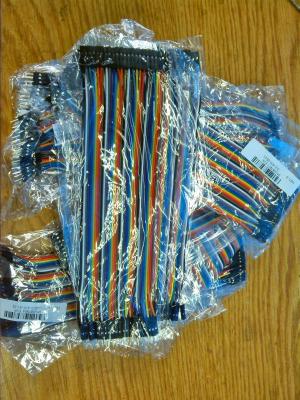
Essential Connectivity: Jumper Wires for Prototyping
Mastering Modular Interconnects in Electronics
Jumper wires serve as the fundamental nervous system of any electronics project, providing the modular connections necessary to bridge components on breadboards, development boards, and breakout modules without the need for permanent soldering. Available in three primary configurations—male-to-male (M2M), male-to-female (M2F), and female-to-female (F2F)—these wires allow for rapid iteration and troubleshooting. M2M wires are the standard for breadboard circuits; M2F wires act as extensions, perfect for connecting a female header pin on a development board to a breadboard; and F2F wires are essential for joining modules with male pin headers, such as connecting an LCD screen directly to an Arduino. Understanding when to use each type is vital for maintaining signal integrity and ensuring clean, organized circuit layouts.
Reliable connectivity in smart home projects relies not just on the type of wire, but on the quality of the crimp and the wire gauge. While standard 22-26 AWG jumper wires are sufficient for low-current logic signals and communication protocols like I2C or UART, they are not intended for high-current applications such as powering motors or heating elements. For robust, long-term installations, it is best to use jumper wires as a temporary development tool, eventually transitioning to soldered headers or custom wire harnesses. To avoid common pitfalls like intermittent connections or "ghost" signals, ensure that pins are fully seated in the sockets and avoid running long, unshielded signal wires near high-voltage AC lines to prevent electromagnetic interference.
Specifications for Jumper Wires (20 cm)
| Connectors | Male to Female or Male to Male or Female to Female |
|
Connectors |
Male to Female , Male to Male , Female to Female |